Guides
Guide to Well-Being and Concentration
This is a quick guide with practical tips for students, to help you manage your day-to-day life better, reduce stress and improve your attention. These are tools to strengthen your skills.
Key ideas:
- Get better organized: List tasks, set reminders and break big jobs into small steps so you don't get overwhelmed.
- Control your attention: Put away distractions (like your cell phone) when you need to concentrate and practice thinking before you act.
- Take care of your energy: Exercise, take short breaks to move, and spend time doing the things you enjoy and are good at.

Guide for Parents: Visible Learning
Based on the research of Visible Learning by John Hattie. Fundamental keys for families to enhance learning from home:
- 1. Adopt an authoritative parenting style: It is essential to combine warmth and emotional support with clear and reasonable rules. Autonomy support fosters their internal motivation.
- 2. Maintain high and realistic expectations: What you believe about your child's ability directly influences what the child believes about themselves. Immaturity is not a fixed state.
- 3. See mistakes as opportunities: It is vital that the home is a place where making mistakes is acceptable. Failure is not lack of ability, it is an opportunity to try something different.
- 4. Encourage "self-monitoring": Help your children plan and evaluate their small tasks by asking, "How am I doing?" or "What step should I take next?".

Parents' Guide: Immature Executive Functions
Based on the book "Late, Lost, and Unprepared" by J. Cooper-Kahn and L. C. Dietzel. Key advice for those cases of children with immaturity in executive functions:
- 1. Understand the “execution gap”: It is not a character flaw, a lack of motivation or a lack of intelligence. It is a performance disability: there is a gap between what they know and what they can do independently.
- 2. Accept inconsistency: The hallmark is that one day they can do something brilliantly and the next day fail. It is a biological irregularity, not an attempt to fool you or laziness.
- 3. Create a "prosthetic environment": Just as a broken leg needs crutches, they need external support from adults (lists, reminders, supervision) while their skills finish maturing.
- 4. Adjust the bar (goodbye to “should”): Expectations should be based on their unique profile, not on their age or year group. If they keep failing, adjust the bar so they can experience small victories.


Guide for families: How to use this website
This page is not just a diary of activities; it is a communication tool designed to build a direct bridge between the school and your home. Reading what we do here will help you understand which skills (self-control, managing frustration, respect) we are working on with your children. If you understand these challenges at home, you can value them, talk about them with your children and reinforce them. A student's success multiplies enormously when the family and the teachers look in the same direction.
What will you find? (Sections):
- History: The day to day of the group. Here we transparently explain weekly challenges, conflicts and successes to understand how they evolve.
- Circles, Activities and Trips: The dynamics, outings and reflections we do to forge their character and prepare them for their future.
- Scientific Contributions: Practical, science-based advice (such as John Hattie's) so that families can help at home as effectively as possible.
How to navigate the site (Usage Tips):
- Smart filters (at the very top): You can click the category buttons (e.g.: "Self-Esteem", "Circles") to see only the cards that talk about that topic. You can press the "Clear filters" button at any time.
- Change view (Top right buttons): You have buttons to change how the information is displayed. You can choose "2 col." to see it in a neat grid form, or "Ext." to spread the cards horizontally and read more smoothly.
- Images and more details: If you click on any image, it will open large so you can see the details. Also, if you press the magnifying glass (or the links on the cards), you can see the information more clearly and, in some cases, access extra content or tips.
History
Last weeks of the course: Individual advances and balloon modelling
In these last weeks of the course we have had many absentees, whether due to expulsions, absenteeism or because, in the case that has worked best, the student prefers to stay in class and try to make progress in their work and improve their grades.
So we have had sessions with just two people, or sometimes even a single student who, rather than wanting to work, needs to relax. In the last period we had 3 people, to whom we suggested a balloon-modelling activity (blowing up balloons to make figures). It was a creative opportunity and a way to relax by doing something fun. However, the result was poor because they still find it hard to accept guidance, to put it mildly.
Leaving the final reflections for a future conclusions card, I think it is very good to note that some of them now prefer to stay in class and are managing to pass their subjects. For us teachers, helping even one person move forward makes all the effort worthwhile, and the truth is that we have seen some degree of improvement in every student.
Anger management: Dialogue and character building
This week we faced a complex situation in which a student lost control and went as far as making threats. In response, we remind ourselves that school must be a forger of character: a place where you find understanding when you need it and where people help you build your strengths by adding values, principles, patience, intellectual rigour, observation (inner and outer) and motivation.
In the hours we share, especially after situations that result in reprimands and expulsions, we try to connect with them to listen to them in their process of accepting the gravity of the situation experienced. We want to convey to them that we do not feel disappointment, but that we still believe that they can improve their self-control. Understanding that self-control is part of the natural process of maturing that each person undertakes at their own pace helps them, especially if they focus on it and reflect on it.
We talked about it as a group, with the help of colleagues from the Per Ells project, each contributing what they can to understand the situation and the emotions. What triggered the situation? What did you feel just before and after? What perceptions are behind all this? How was the week before the event? What hasn't worked with the tools we've already talked about? (since learning involves repetition to acquire skills). What tools can we have to help manage these situations? These are questions that we intersperse in their dialogue, focusing on the time we share to give them a firm hand to hold on to in order to understand the situation and look for a way out that is functional in their lives. Clear ideas about responsibility, but understanding, to be able to establish the link that allows them not to disconnect from the work we do at the IES, not to despise everything and themselves, and not to throw everything overboard.
The school's mission is to help them get on in life with everything that prepares them intellectually, emotionally and socially; responsibility, patience, self-control, and understanding and valuing what surrounds them are key to their future. These are keys we must be able to inspire in them, not through fear or harshness, but through example and our own maturity and responsibility. Through our own awareness.
Adaptation week: advice among classmates and a new member
This past week we had to adapt to having fewer teachers and fewer hours for the "Per Ells" project. In addition, a new student has joined who, at certain times, also needs a space outside the ordinary classroom to calm down. On Friday, it was the boys themselves who took the initiative and explained to their new classmate what our space is about.
The week passed with a very valuable dynamic: they themselves gave advice and assessed their own situations. Among the conclusions they drew and shared, three clear messages stood out:
- They told a classmate to stop thinking he was incapable (using his own words), reminding him that he is smart and can study if he wants to.
- They concluded that it is necessary to study English and mathematics because they are very important tools for their future.
- They advised each other about the need to pay more attention in class.
We believe that it is essential that they themselves learn to evaluate these situations and focus on their own paths. For my part, on Friday I wanted to insist on our red lines: we can talk and debate things, however the teacher, if necessary, has the last word in the decisions. In addition, Mutual respect and respect for teachers is non-negotiable.
We are here to help if we are needed, however You can't help someone who doesn't want to be helped. The truth is that we continue to see real improvements in their attitude, and that is what really encourages and gives meaning to this project.
This week's image represents this extraordinary but possible future. A dream yes, but you never know. What we do know is that to be there or in any universe worth being in, you have to focus and try harder than others who also want to achieve it. This is true for any dream.

Changes, the purpose of the group and our true goal
This week there have been important changes: the resources devoted to the group have been reduced because Carina is no longer with us. This has made them think that the group is disappearing. We have tried to show them that this is not the case: if they need us, they can still leave class and come with us to work on their skills to reduce conflict and how serious these conflicts become.
It is vital that they do not think they are incapable of learning. If anything, there may be some accumulated academic delay, but at these 2nd or 3rd ESO levels, putting in the effort and getting results is totally viable. The main goal of this project is not to help "less intelligent" people, because that is clearly not the case.
Our purpose is clear: helping and bringing back students who are dropping out of the system, not working and unable to function in a class without conflict.
They must be able to be in classrooms without confrontations, obeying the teacher's instructions naturally and tolerating frustration, without blocking the natural course of a class with challenging attitudes.
Last two weeks: vertical garden, farewell and taking stock
For the past two weeks we have been very focused on building and finishing our vertical garden. We also took the opportunity to say goodbye to Pere Miquel Pol. To do so, we met in the UECO classroom, where we cooked a lunch and some desserts that we shared with everyone present. We want to thank Pere sincerely for his patience and good humour during the weeks he was able to work with us.
Taking stock of the evolution of the group, we are noticing very positive improvements in a couple of them: better mood, less conflict and more desire to work in class. However, we continue to have significant challenges ahead. Another student has shown an increase in conflict and has received reprimands for disrespecting his teachers in the regular classroom, unable to take control of his impulsivity or to inhibit himself minimally. We have to work hard to help him acquire a modicum of self-control and responsibility.


Maths reinforcement and the challenge of visits to vocational training centres
Last week we focused a lot on maths to reinforce the basics. We worked on mental arithmetic by reviewing multiplication and division tables. We also learned very useful tricks for everyday life, such as adding or subtracting percentages with a single multiplication (for example, calculating a 10% discount by multiplying directly by 0.90) and solving simple equations by operating with negative numbers, understanding what happens when calculating expressions such as 5x - 9x.
We also continued looking at Vocational Training (FP) options for their future. Unfortunately, we ran into a recurring problem again: embarrassment. This insecurity blocks them and prevents us from visiting different secondary schools (IES) to learn first-hand about the possible options. These visits are extremely valuable for their future, but it is a shame that we cannot go ahead with them if they refuse and block them for fear of what people will say.

Week of Inclusion, Self-Esteem and Recognition
This past week several students were absent and some classmates were away on a school trip. With those who were here, we took the opportunity to keep working on self-esteem through reading and writing.
We also went on a couple of outings and cooked together with the group from the UECO classroom. This brings great value in terms of inclusion at the school and serves as clear recognition of their improved behaviour and better marks.
They have more than earned this reward through their effort over the last few weeks, in which they have worked on very powerful activities: from reflecting on and debating values such as respect and empathy based on videos, to looking towards their future by writing their own CV and identifying their strengths. Seeing them reflect on and share these ideas has been a big step.

Progress in their capacity for work
We have several students getting more involved in working or even studying with us. They are increasing their capacity for effort, which gives us a glimpse that our dedication to this project could be yielding the first positive results.
However, we still need to help them know how to inhibit themselves in situations where they get angry with peers and teachers. It is essential that they learn not to escalate the seriousness of situations, as this impulsive attitude only takes them away from their own positive future.

Advances, dilemmas and the challenge of self-control
Last week we saw that there is progress with us. The boys are making an effort to improve and to come with us. There is a dilemma that I, at least, am clear about: should we try to save a student who openly confronts the teacher or teachers he dislikes and who is seen as very disruptive, provocative or even aggressive?
Last week we had someone who was openly threatening to lose control, and our job was to help him not to escalate the situation. In fact, once he was relaxed he worked on his writing skills.
Do you remember when we were little and were taught how to hold a pencil to write, and it was hard, it even hurt and left a mark on our finger because we didn't yet know how to grip gently? Well, that was the step taken on Friday. We were really pleased to see it and we hope it will consolidate and help his self-image, which is one of the key points that weaken self-control.

Personalized attention and firmness in the rules
Last week we also had Pere Miquel Pol with us, who is temporarily replacing Carina. His arrival allowed us to split the group in two to better meet each person's needs: Pere Miquel spent two hours helping Aitana study History, so that she could be fully focused. Meanwhile, the rest of us went out for a walk and talked about the situations they wanted to reflect on, without disturbing their classmate's concentration.
On the other hand, we remain very firm about one fundamental rule: students cannot leave their class on their own to come with us. It is the project teachers who go and fetch them. Moreover, belonging to the group is a privilege that requires responsibility: they can only come if they are willing to work and are not disrupting the normal pace of their classes.

A forced break and a new stage
After a few very difficult weeks, marked by the group's strong rejection of the rules, medical leave and other urgent duties demanded our attention. This forced distance made the boys think: they understood that our help is voluntary and that, if all they want is conflict, we will invest our energy in those who do want to learn.
This change in attitude has coincided with the arrival of two new teachers (and the departure of one), who have brought their own personal skills and approaches to everyday work. They have shown them that every person is unique and that we can learn something valuable from everyone. The video accompanying these lines finally shows them focused on their tasks. It is the image that gives us the most satisfaction, because helping them move forward is our true reason for being here.
Week 2 2026: Effort and Satisfaction
This week we focused on the new typing activity, a tool to work on attention, persistence and frustration management.
The most remarkable thing is that throughout the week the boys behaved well and kept working. This is a source of great satisfaction, as we can see them regaining opportunities for their future.

1st Week 2026: Prize and Advances
As a reward for good behaviour, we went out for a hamburger. The one who, to impose his point of view, called the teacher "a pain" six times did not take part.
For the teachers, it is an important step forward that one of the boys uses his time with us to do his homework. It shows that he realises we are trying to build something positive.

Week 12: Taking stock and pre-Christmas decisions
The Christmas holidays arrive and we find ourselves at a critical moment: with several members expelled or in the process of being expelled, and with provocative behavior that seeks expulsion, such as vaping in front of the headmistress. It's time to take stock.
Exploring Vocational Training (VET):
As a step before visiting other schools, we tried to get to know the vocational training at our own school. Although they are gradually overcoming their initial "no", their resistance peaked when they refused to enter one of the computer rooms, even when warned they would be reprimanded. Meanwhile, in the workshop, they did achieve successes such as climbing onto a Leonardo bridge they had built.
Moment of Reflection and Self-Assessment:
This week marks a turning point. It is time to reflect, assess the project, meet the parents and, with all the information gathered, decide who can stay in the group and which new members we can take in.

Week 11: Chess and Clear Limits
This has been a slower week, marked by the absence of several members of the group who had been suspended for bad behaviour. This has led us to reinforce the foundations of respect and of how the project works.
Activities and Objectives:
We went shopping, played chess to work on patience and strategy, and tried to get them to enjoy the tech workshop. The main challenge is to make this group viable for them, which requires bombproof patience, but also that they deserve the chance.
Reinforcing the Rules of the Game:
To facilitate the process, we have decided to clarify ideas explicitly, establishing firm and non-negotiable limits:
- "You can propose activities and we will listen to you, however it is the teachers who decide what is appropriate."
- "At no time disrespect is tolerable."

Week 10: Salchipapas under Control
This week we repeated the salchipapas activity, but with a key difference: strict external monitoring by teachers to ensure that the process was completed correctly. The experience has been extremely difficult, but it has served to highlight the real difficulties they have in managing frustration and accepting limits.
Controlled Activity and Reactions:
- Extreme resistance: During the process, the response to the control was very hostile, with pushing, insults, belittling and even threats to break the plate if they were not given what they wanted.
- Another focus of conflict: A student wrote a serious insult aimed at a teacher on a desk and signed it with her name. Her apology, which lacked sincerity, turned into anger when it was not received as she had hoped.
The Lesson: External Control as a Bridge to Maturity
The process, partly supervised by the head teacher, has shown that external control is a necessary step. If they cannot wait as a group for the food to cook, or cannot handle frustration without insulting people, restraint has to come from outside. The aim is for them to gradually build their maturity and their ability to correct themselves and notice when they are not behaving properly.

Week 9: The Salchipapas Finally Arrived
The long-awaited salchipapas activity turned into an intense practical exercise in impulsiveness, negotiation and keeping agreements. The result was a clear lesson about the consequences of our actions.
The Salchipapas Challenge:
- The Pact: Before we left, we agreed that there would be no attempted theft. However, they constantly pushed to end the conversation quickly instead of listening.
- The Negotiation: On the way, they refused to go to the supermarket chosen by the teachers, forcing the group to go to the one they wanted.
- Impulsivity: Inside the supermarket, they preferred to buy twice as many potatoes and salsa as needed, acting rashly and without planning.
- The Result: On the way back, they rudely demanded control of the whole cooking process, took the potatoes out too early and shared them out among themselves without agreement. Result: undercooked salchipapas and internal conflict.
Reflection and Consequences:
- The Failed Dialogue: The next day it was impossible to talk about it. Even though there were only 5 of them, they could not listen without making fun of the head teacher, and some had to be taken out to calm them down.
- Rules for living together: They were reminded that they must wait in class. Because they did not, they were sent back upstairs and lost an hour of activity before the conversation.
Week 8: Workshop, Smoothies and Civility Challenges
This week, with lower attendance, we focused on practical activities and on how the group present got along. The aim was to keep a constructive dynamic while some classmates concentrated on passing exams or faced the consequences of past actions.
Activities Carried Out:
- Technology workshop: We made progress on hands-on projects, encouraging concentration and practical skills.
- Fruit smoothies: A healthy and collaborative cooking activity to start the day with energy.
- Walking and football: Time for recreation and for observing how we behave outside school.
- Emotional dialogue: We continued to talk about the situations that affect us in order to learn how to manage them.
Challenges and Areas of Improvement:
- Lack of civility: Inappropriate behaviour arose during the walk (hitting someone's property, dirtying a wall, crossing on a red light against instructions). This is a critical area that we urgently need to improve.

Week 7: Language vs. Responsibility
This week we focused on analysing "prison language": a communication pattern based on accusations ("snitch"), threats and avoiding responsibility. We contrasted it with the adult attitude of accepting the consequences. We used the fact that several members of the group have been victims of these dynamics to reflect with empathy.
Progress and Positive Points:
- Better relations in the group: Paco stopped his disruptive behavior towards Ester after a warning.
- Moments of connection: We enjoyed fun activities (ball games) and creative activities (AI class), strengthening the group.
- Greater involvement: A general improvement in attention and active listening is observed, especially during the reflection circle.
Difficulties and Learnings:
- Non-compliance with rules: A student brought a vape. He has promised not to do it again, on pain of a sanction.
- Minor incident: Another student mistakenly threw a ball into a neighboring high school.
- Serious consequences: A member of the group was suspended for recording a video of a fight, a criminal act whose seriousness he was not aware of. It is a crucial lesson in digital responsibility.

5th and 6th Week: A step back to gain momentum
These two weeks have been a reminder of the complexity of the path. We face significant setbacks that are crucial to understanding the real challenges we face.
Challenges and Difficulties:
- Serious disobedience: Persistent refusal to follow basic rules (mobile phone use), which ended with a student refusing to speak to the school management and being temporarily suspended.
- Attempted theft: During an outing to the supermarket, followed by lies to cover it up.
- Attitudes of exclusion: One student, with the support of others, treated a classmate aggressively to discourage her participation in the group.
Progress and Work Points:
- Executive functions: Despite the incidents, their ability to listen and to respect speaking turns is improving.
- Acknowledgment of errors: Those involved admit they acted wrongly, an indispensable first step.
- Goal Awareness: They understand the need to learn to control themselves in situations like the supermarket.
- Language analysis: We are working on identifying and dismantling destructive communication patterns (threats, deception, calling people "snitches", etc.).
Fourth Week
We keep up the effort.
Improvements observed
- The classmates try to help Cristian.
To improve:
- Disrespect towards teachers.

Third Week
Busy week, but with a good ending.
Improvements observed
- Better behavior at the end of the week.
- We enjoyed the circles and the games.
- Respect has improved.
- "I've never been this long without expulsions."
To improve:
- Getting the forms signed in order to take part in outings.
- Maintain substantial improvements in self-control.

Second Week
We chose who could go and buy ingredients based on reliable behaviour and signed forms, and we made crêpes. We also worked on frustration and emotion circles to improve self-management with understanding. Being in the group is a privilege that should not be wasted.
Improvements observed
- Some show a little more responsibility and admit mistakes.
- A little more patience.
- A little more understanding.
- There is demand at the school from more students wanting to join the group.
To improve:
- Have the papers signed to participate in the outings.
- Disrespect even towards the head teacher.
- They need to focus on obeying the teachers more so that they can help them.

First Week
We wrote down the timetables in the head teacher's office while we were fresh, taking turns to speak. Afterwards, we went out into the playground garden and, in the shade, played a game to see who could last longest without making a sound.
Improvements observed
- Respecting the teachers of this group.
- Trying to listen to others in turn.
- Writing down the timetables.
To improve:
- Doing activities to laugh about who can tell the biggest tall tale.
- Avoiding provocations… such as throwing stones.

Circles
Circle of Emotions
An activity to name what we feel. We explore the different emotions, from the most basic to the most complex, learning to identify them in ourselves and in others in their different degrees.
Key objectives:
- Recognize and name feelings.
- Understand the difference in intensity in each emotion.
- Develop empathy and active listening.
- It is the first step in learning to manage ourselves.

Everyday life and experiences
- What is the best memory you have from your childhood?
- What activities do you like to do after school?
- What place in your city/town would you recommend to someone coming to visit?
- If you could change something about the school, what would you change?

Identity and relationships
- What is a good friendship for you?
- How do you feel when you work in a team?
- What qualities do you value most in a person?
- What makes you proud of yourself?

💡 Simple opinions and discussions
- Is it better to have many friends or few but good ones?
- What is the best invention of recent years?
- Is it better to read a book or watch the movie based on it?
- Do social networks help or complicate our lives?

Values and Today's World
- What can we do to take better care of the environment?
- What small actions can make the world fairer?
- What does "being responsible" mean to you?
- What role does sport play in your life and in society?

Creativity and imagination
- If you could travel in time, where would you go and why?
- If you were a superhero, what powers would you have and how would you use them?
- What would your ideal school be like?
- If you could invent a new object, what would it be?

Trips
Going to the supermarket: a self-control exercise
More than just going out, going shopping in a supermarket is an intensive exercise of self-control and executive functions. The barrage of stimuli, the possibility of shopping, and the reward of eating something create an emotional intensity that is difficult to manage for someone with little self-regulation.
Challenges and Behaviors Observed:
- Temptation and impulse control: The need to actively prevent products from being pocketed is constant. It's not theory: the first group tried it en masse, going so far as to lie after being found out.
- Frustration Management: Their disappointment at finding a restaurant closed was so great that it led to insults towards the teacher, and so they lost the chance to be treated to an afternoon snack.
Evolution Analysis:
They are improving, but it gets harder when we become firmer in stopping serious misbehaviour. Their response tends to be to block the activity and openly disobey. So, although they are slowly making progress with patience, they also resist maturing, preferring to get their own way and blame others.
Conclusion: It is a very intense activity of self-control and self-monitoring where those who manage to be more mature stand out.

Municipal Markets
- Get to know the Municipal Markets of Palma.
- Compare product prices.
- Get to know seasonal products.
- Make the shopping list and buy fruit.
- Cook a healthy recipe (e.g. fruit skewers).
Company Visits
- Get to know different trades first hand.
- Learn about rules of conduct at work.
- Explore possible career paths.
Statistics on the Street
- Count cars of different colors on specific streets.
- Draw conclusions: which colors predominate?
- Make a graph with the final results.
Outdoor Conversation Circle
Sitting on the ground or on benches, we discuss a topic in a more relaxed setting than at school, encouraging communication and respect.
Writing or Drawing Outdoors
Bring notebooks and pencils, and spend time creating a text or a drawing inspired by what we see around us.
Activities
Construction of the Vertical Garden
This activity was very special. For two weeks, the students enjoyed building and planting this wonderful vertical garden. It was steady work in which we worked on habits, caring for our surroundings and, above all, patience.
The day they saw the final result and how beautiful everything looked was a great reward for them. In the pictures you can see the whole process: from the preparation, putting in the soil , through the watering, to the final result at the school. There are also some beautiful macro photos showing water droplets glistening on the flowers.

Gallery of the process and details:


Reflection on Values through Videos
Tomás, Mateu and Fernando: In this activity, the three students watched different videos related to values, such as respect, empathy or cooperation. Each student watched the videos carefully and then wrote an individual reflection on what they had understood, what values appeared in them and how they could be applied to everyday life.
Once we all finished our reflections, we shared them. Each student explained their ideas and opinions, and we all commented on the aspects that had caught our attention the most. This allowed us to hear different points of view and better understand the meaning of the values that appeared in the videos.
With this activity we learned how important it is to reflect on values and share opinions with others. We also practised active listening and respect for our classmates' ideas. The activity aimed to encourage personal reflection, critical thinking and positive relationships among the students.
Our Future: Writing a Personal CV
Paco, Aitana, Fernando and Mateu: In this activity, four students reflected on their personal and professional future. First they thought about who they are, what their qualities are and what they like or what motivates them. Based on this reflection, each student wrote a kind of personal CV.
In this document they explained different aspects: who they are, what they would like to do in the future, what steps or studies they think they need to follow to achieve it, what their strengths are and what their motivations are. They also wrote what they have achieved so far and what experiences, skills or learnings they consider important.
After writing their CVs, they shared some ideas with the rest of the group and talked about each person's goals and interests. This allowed them to get to know their classmates better and to see that everyone has different paths and aspirations.
With this activity they learned to reflect on themselves, identify their strengths and think about the future more consciously. The aim of the activity was to get to know themselves better, set goals and start thinking about the steps they can take to achieve them.
Olfactory Sensations: Discovering Aromas
In this activity we explored the senses in a different way: we let them smell various air fresheners and colognes to see if they could recognise them. We used a wide range of scents, such as chocolate, rose or lemon, among others shown in the photo.
Closing their eyes, concentrating on the smell and trying to guess what it was turned out to be a very stimulating experience for them, without a doubt. We saw that using people's natural curiosity is a great incentive to encourage their participation and interest in a playful, relaxed way.

Sensory Approach: Minerals and Semi-Precious Stones
We worked on minerals and semi-precious stones through a sensory approach. It is an activity that appeals directly to sight and touch, and it strongly reinforces the desire to learn about the natural world.
We had different minerals labelled with their names, as well as marbles, which also served as practical, visual examples. At the end of the session we let each of them leave with a really special marble as a gift, and they were delighted.
Curiosity combined with sensory stimulation are unparalleled engines for learning.

Typing: Building Character and Skills
Learning to type is a fundamental activity in our project. Beyond typing fast, it's a powerful exercise in strengthening key executive skills.

Translation of Late, Lost, and Unprepared by J. Cooper and L. Dietzel
"TIP: It makes a lot of sense to teach children keyboarding skills in the early years of primary school. Using a computer to write saves the child from having to rewrite work when adding or correcting things. The computer also offers various software options that make written work less tiresome. Learning to type can be quite tedious, so you may need to build in some meaningful reinforcement to get enough time and effort devoted to it. Some children do better working with a tutor or occupational therapist for several sessions to make sure they develop good finger positioning. There is also a range of software programs that teach typing and monitor progress. They come in many different versions, some incorporating elements of inherent interest to the child, such as characters from popular video games or sports-game formats. Many children will do better with reinforcement to complete the practice needed to master this skill. Many schools teach typing, although you may want to speed up the pace of learning by teaching your child at home or making it a summer project. Consider asking your school which software they use and perhaps getting the same program. In fact, some software publishers have arrangements that let you order the software through the school at a reduced price."
Our Approach:
We consider this activity a character builder for several reasons:
- Sustained attention: It requires an effort of concentration for about 40 minutes.
- Emotional Management and Self-Esteem: It makes them feel the discomfort of continuous hand control, learning to manage it and strengthening their self-esteem by overcoming the challenge.
- Visible Results: They see improvements at every step, which reinforces their perception of effectiveness.
- Transversal Skill: It indirectly reinforces literacy, a tool that limits or enables all of their future study efforts.
Personalized Learning with AI
An activity where we learn to use Artificial Intelligence (like NotebookLM) to research our interests, organize information and create tailored resources, like the "Wellness Guide".
Principles of use:
- AI as an Assistant: It is a tool to accelerate learning, not to think for us.
- It does not replace the teacher: The teacher guides the process and validates the information.
- Be Skeptical and Check: The most important rule. We must always verify the data and cross-check the sources that the AI gives us.

Leonardo Bridge
We build a replica of Leonardo da Vinci's self-supporting bridge, using only wooden slats and no fasteners.
Skills worked on:
- Problem solving and spatial thinking.
- Teamwork and effective communication.
- Patience, precision and fine motor skills.

Climbing the Leonardo Bridge
A fun and practical activity where the students could see for themselves the solidity of Leonardo da Vinci's ingenious self-supporting design.
The process had two key phases:
- Construction: First, they assembled the bridge as a team, fitting the wooden slats together without the need for nails, screws or ropes.
- Load test: Then the bravest climbed on top, demonstrating with their own weight the incredible resistance of the design.

Creating Videos with AI
We teach students to interact with Artificial Intelligence tools to transform their ideas and passions into short videos. The goal is for them to learn how to give precise instructions (prompts) to guide the AI and get a creative result.
Key skills:
- Development of digital competence.
- Fostering creativity and personal expression.
- Practice patience and problem solving.

Results: Videos Created with AI
These are some of the videos generated by the students during the activity. Each one reflects their personal interests, from nail aesthetics to racing cars.
Luminous Nails (Aitana)
Racing car (Paco)
Chase (Paco)
"We are happy" (Nando)
Another joke (Nando)
Vertical Garden with Pallets
An activity that combines recycling, nature and manual work. We turn a wooden pallet into a vertical garden to decorate our school and learn about the life cycle of plants.
Objectives of the activity:
- Encourage recycling and reuse of materials.
- Learn basic gardening and plant care techniques.
- Work as a team to plan and build the garden.
- Improve the school's surroundings with a natural, creative element.

Creativity with Artificial Intelligence
In this activity, we explore the world of generative AI. Each student uses Gemini to create images from textual descriptions (prompts), a great way to encourage creativity, expression and digital competence.
Skills developed:
- Writing effective prompts to obtain the desired results.
- Artistic expression through technology.
- Critical thinking to analyze and refine the generated images.
Results generated in class:


Weekly/Fortnightly Blog
Creating content for the school blog, covering topics such as:
- School news.
- Activities and trips carried out.
- Cooking recipes.
- Sports and leisure.
Cooking
Complete process for making a recipe:
- Make the shopping list.
- Buy the ingredients.
- Write and explain the recipe.
- Prepare the dish as a team.
Make a Bouquet
A relaxing manual activity that connects with nature and encourages attention to detail. The process consists of:
- Stroll through the orchard or garden to observe and pick flowers and leaves.
- Learn to identify some local plants and their characteristics.
- Carefully cut the selected parts.
- Compose the bouquet creatively, combining colors and shapes.
Creative Photography
Thematic photo challenges, where students go out around the school or the surrounding area to develop their artistic vision. Some possible challenges are:
- A dominant colour (e.g. “find everything that is red”).
- Small objects or details that usually go unnoticed.
- Reflections (mirrors, glass, water).
- Textures (walls, wood, clothes).
When finished, the photos can be printed to create a mural, a collage or a collective photo book.
Vegetable Garden
Looking after the school's vegetable garden, learning about the plant cycle, responsibility and teamwork.
School Maintenance
Collaboration in basic facility maintenance tasks, encouraging responsibility and learning practical skills.
Vivarium
Care and maintenance of the vivarium, learning about ecosystems, animal biology and constancy.
Recycling Program
Running the school's recycling system, promoting environmental awareness and organisation.
Applied Technology Workshops
- Video production and editing.
- Content creation for social networks or blogs.
- Introduction to graphic design.
School Decoration
Taking part in decorating the school according to the season or for special events (Christmas, spring, etc.).
Relaxation
Relaxation and mindfulness activities to manage stress and improve concentration, such as painting mandalas.
Scientific Contributions
Below is a summary of the most effective ways to support struggling students, based on research from Visible Learning by Hattie and related frameworks:
The Teacher's Mindset
Hattie's starting point: A teacher's belief in their ability to make an impact is the key factor in student success. The keys are:
- Constantly evaluate your own impact.
- Have high expectations for everyone.
- Create a culture where failure is an opportunity.
High Impact Strategies
In addition to mindset, there are teaching methods that have been empirically proven to be very effective in accelerating learning. Among them:
- Direct and explicit instruction.
- Teaching metacognitive strategies.
- Use of solved examples (Worked Examples).
- Response to Intervention (RTI).
Effective Feedback
Feedback is one of the most powerful tools, but only if it's done right. It must be information that helps the student to move forward. That is why you must:
- Answer: Where am I going? How am I doing? And now, where?
- Focus on the task or the process, never the person.
- Be specific, clear and actionable.
Positive Learning Environment
Nothing works if the classroom is not a safe, orderly and trust-based space. The climate of the classroom is an indispensable condition for learning. It requires:
- Build positive and trusting relationships.
- Clear and consistent classroom management.
- Explicitly teach behavioral skills.
- Encourage dialogue and active listening.
References
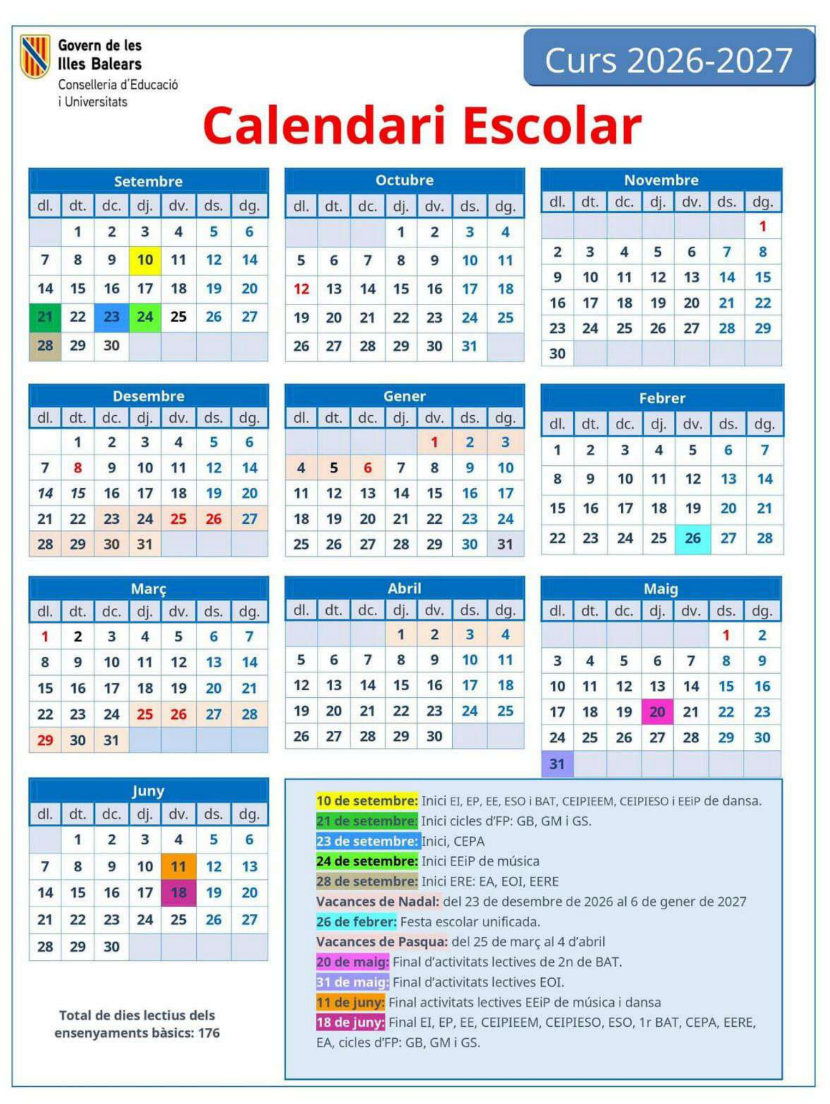
Calendar
This calendar is available on the school's website so you can check which days we have classes.
Tools of the Support Guide for Neurodivergences
A website with concept maps, visual guides and strategies for teachers. This material is particularly useful for accompanying students who already have a diagnosis of neurodivergence, offering specific tools for the classroom.

ICT tools for organization and communication: Telegram and this website
The current team uses Telegram and this website as the main technological tools for organizing and communicating. Nothing that comes from a company that gets rich by collaborating with genocide.
- Telegram: works very effectively to coordinate with each other, share reminders and keep the day-to-day running of the project.
- This website: allows families to have weekly access to information about what we are working with the boys and the difficulties we are trying to overcome.
- Flexibility: being able to visit the website at any time, and the amount of information we can share in different formats (text, images, videos, etc.), make it easy to adapt to different audiences and interests.


